
Download the slides with speaker notes here:
Preview them as PDF:
General speaker notes
Marcelle Soares-Santos works in multi-messenger astronomy to measure cosmic acceleration and understand the nature of dark energy. She contributed to the construction of the Dark Energy Camera (DEcam) for the Dark Energy Survey (DES). The DES is an international collaboration of researchers that aims to constrain the properties of dark energy using near-ultraviolet, visible, and near-infrared imaging of supernovae and galaxies. Using the DEcam, Soares-Santos and her collaborators were able to detect the electromagnetic counterpart to the gravitational wave event GW170817 due to the collision of two neutron stars in the galaxy NGC 4993.
Soares-Santos was born and raised in Brazil, where she studied physics at the Federal University of Espírito Santos and received her bachelor’s degree in 2004. She completed her graduate studies in astronomy at the University of São Paulo, where she received her M.Sc. and Ph.D. in 2010. In the same year she moved to the U.S. and became a Postdoctoral Research Associate in Astrophysics at the Fermi National Accelerator Laboratory (Fermilab) in Batavia where she helped build the DEcam. She received the Alvin Tollestrup Award for her work at Fermilab in 2014. She then became an Assistant Professor of Physics at Brandeis University in 2017, was awarded a Sloan Research Fellowship in 2019, and has been an Assistant Professor at the University of Michigan at Ann Arbor since 2020. Her research was recently featured in the PBS documentary series “Nova Wonders”.
Dark energy is the name given to the unknown force that drives cosmic expansion. The first evidence of dark energy came from observations of distant supernovae which showed that the Universe does not expand at a constant rate. Supernovae are used as “standard candles”: astronomical objects that produce light of a known brightness as its source. Measuring the rate of cosmic expansion involves comparing the light’s observed brightness, known brightness at the source, and its recorded redshift. Recently, cosmologists have begun to use gravitational wave sources as “standard sirens” to directly determine the rate of cosmic expansion. Soares-Santos searches for gravitational wave-emitting events as well as employs traditional methods such as galaxy clusters and gravitational lensing to further the understanding of the accelerated expansion of the Universe.
https://lsa.umich.edu/physics/people/faculty/marcelle-soares-santos.html
https://www.darkenergysurvey.org/the-des-project/science/
https://en.wikipedia.org/wiki/Dark_Energy_Survey
https://en.wikipedia.org/wiki/Marcelle_Soares-Santos
https://astrobites.org/2021/01/09/meet-the-aas-keynote-speakers-dr-marcelle-soares-santos/
Slide-specific speaker notes:
Science details:
Accelerating masses cause gravitational waves which are ripples in spacetime. In 1916 Albert Einstein predicted the existence of gravitational waves in his general theory of relativity. The theory showed that massive accelerating objects (such as supernovae, or binary systems of stars and/or black holes) would cause waves of spacetime to propagate at the speed of light in all directions away from the source. These waves are invisible but squeeze and stretch spacetime as they pass by. In September 2015 LIGO made the first direct confirmation of the existence of gravitational waves. This was due to the collision of two black holes 1.3 billion light-years away. The event caused a ripple in spacetime on Earth that was 1000 times smaller than the nucleus of an atom. In October 2017, the LIGO and Virgo collaborations announced the first detection of gravitational waves originating from merging neutron stars in a binary star system.
In the 1990s, observations of supernovae were the first indicators of the existence of dark energy, which showed that the Universe’s expansion is accelerating - when it was previously thought that the expansion should decelerate over time. Dark energy describes the unknown force that causes this expansion. When the Universe expands, it stretches the wavelength of radiation (gravitational waves, electromagnetic radiation) causing it to shift toward the red end of the electromagnetic spectrum (redshift). Detections of gravitational waves can provide information about the current rate of expansion of the Universe and the composition of dark energy.
Citations and resources:
https://www.ligo.caltech.edu/page/what-are-gw
https://en.wikipedia.org/wiki/Gravitational_wave
https://www.news.ucsb.edu/2019/019393/standard-siren
https://science.nasa.gov/astrophysics/focus-areas/what-is-dark-energy
Figures:
Left: Cartoon depicting cosmological redshift. At an earlier time (left) a photon from a distant galaxy is seen on Earth with an original wavelength (yellow). At a later time (right), when the space between the Earth and the distant galaxy has expanded, the photon from the distant galaxy is seen on Earth with a stretched (redshifted) wavelength (red). https://www.thoughtco.com/what-is-redshift-3072290
Right: Animation of two neutron stars orbiting each other and visualization of the gravitational waves that propagate away from the source. https://www.insidescience.org/news/gravitational-waves-throw-light-neutron-star-mergers
Science details:
When the Universe expands and celestial bodies are pulled away from us, the wavelength of light is shifted toward the red end of the electromagnetic spectrum (redshift). If the source of light is receding faster then the light will be more redshifted. The speed (v) of the object is related to its distance from us (d) by the Hubble constant (H₀): v = H₀d. To understand the accelerating expansion of the Universe, scientists have tried to accurately determine the Hubble constant by measuring the redshift of celestial objects and their distances from us.
This requires a standard candle: an object that always has the same standard brightness. Computing the distance to the object involves measuring how dim it appears on Earth compared to its known brightness at the source. Astronomers need to use a “distance ladder” to calibrate the distances to certain objects using previous measurements of distances to others, which can introduce uncertainties at each step of the ladder.
Citations and resources:
https://www.news.ucsb.edu/2019/019393/standard-siren
https://skyandtelescope.org/astronomy-news/tension-continues-hubble-constant/
Figures:
Depiction of the Three Steps to the Hubble constant. Cosmic structures at different distances from Earth from left to right: Cepheids within the Large Magellanic Cloud (180,000 light years), galaxies hosting Cepheids and Type 1a supernovae (24-100 million light years), and distant galaxies in the expanding Universe hosting Type 1a supernovae (100 million-1 billion light years). The light from the distant galaxies is redshifted (stretched by the expansion of space). https://theness.com/neurologicablog/index.php/mystery-of-the-hubble-constant/
Science details:
When the Universe expands and celestial bodies are pulled away from us, the wavelength of light is shifted toward the red end of the electromagnetic spectrum (redshift). If the source of light is receding faster then the light will be more redshifted. The speed (v) of the object is related to its distance from us (d) by the Hubble constant (H₀): v = H₀d. To understand the accelerating expansion of the Universe, scientists have tried to accurately determine the Hubble constant by measuring the redshift of celestial objects and their distances from us.
Cosmologists currently have two different values for the Hubble constant: one that was calculated using the cosmic microwave background (H₀~68), and one that uses Type 1a supernovae (H₀~73) - both of which have small error bars. This disagreement might mean that there is missing information in the understanding of the Universe’s expansion. Gravitational waves, however, can be used as a “standard siren” to determine the distance to an object and might yield a different value of the Hubble constant. Unlike standard candles, the standard siren does not rely on a distance ladder - the distances can be computed directly.
Citations and resources:
https://www.news.ucsb.edu/2019/019393/standard-siren
https://skyandtelescope.org/astronomy-news/tension-continues-hubble-constant/
Figures:
Left: The Hubble constant calculated using different methods is plotted against time. The Cepheid method (blue) uses Type 1a supernovae in conjunction with Cepheid variable stars, which relies on observations of the current Universe and gives higher values of the Hubble constant. The cosmic microwave background (CMB) method (black) relies on observations of the early Universe and gives lower values. The “tip of the red giant branch” (TRGB) method (red) gives intermediate values. For all methods, the values become more precise and the discrepancy between the values grows over time. https://aasnova.org/2020/07/10/shining-bright-through-the-ages/
Right: Hubble’s Law (velocity = Hubble constant ✕ distance) is shown by plotting velocity against distance for a number of galaxies. Galaxies closest to us are moving away at a slower velocity/speed, and galaxies furthest from us are moving away at a faster velocity/speed. https://astrobites.org/2016/04/20/conflicts-between-expansion-history-of-the-local-and-distant-universe/
Science details:
There are four extrasolar “messengers” in astronomy: electromagnetic radiation (photons), gravitational waves, neutrinos, and cosmic rays. They are called messengers because each signal carries a message containing information about its source. The messengers are created through different astrophysical events such as solar flares, supernovae, gamma ray bursts, active galactic nuclei, relativistic jets, or neutron star mergers. Each type of event produces one or more messengers and gives insights into the processes that created them.
For example, a neutron star collision occurred in the galaxy NGC 4993 produced the gravitational wave signal GW170817 which was observed by the LIGO/Virgo collaboration, a gamma ray burst GRB 170817A which was observed by the Fermi Gamma-ray Space Telescope and INTEGRAL, and ultraviolet, X-ray, and radio signals observed by the Neil Gehrels Swift Observatory, Chandra X-ray Observatory, and Karl G. Jansky Very Large Array, respectively. These combined observations marked a new milestone for multi-messenger astronomy because they were the first detections of a gravitational wave event with an electromagnetic counterpart. Soares-Santos and her collaborators used the Dark Energy Camera (DEcam) to detect these electromagnetic counterparts to GW170817.
Citations and resources:
https://en.wikipedia.org/wiki/Multi-messenger_astronomy
https://chandra.harvard.edu/photo/2018/gw170817/
https://astrobites.org/2021/01/09/meet-the-aas-keynote-speakers-dr-marcelle-soares-santos/
Figures:
Left: Cartoon depicting the four messengers involved in multi-messenger astronomy. The multi-messenger source is a binary star system (white) which emits signals detected on Earth: gamma rays which are absorbed (blue arrows), neutrinos (red arrow), cosmic rays which undergo magnetic deflection (green arrow), and gravitational waves (yellow arrow). https://nbi.ku.dk/english/research/experimental-particle-physics/icecube/astroparticle-physics/
Right: Illustration of a neutron star merger. The stars are shown in blue and white, spacetime is illustrated by grid which is warped due to gravitational waves, which are illustrated in shades of purple. https://chandra.harvard.edu/photo/2018/gw170817/
Science details:
The Dark Energy Survey (DES) is an international collaboration of over 400 scientists from over 25 institutions that aims to understand the properties of dark energy by doing astronomical surveys. Soares-Santos contributed to the construction of the Dark Energy Camera (DECam): a 570-Megapixel digital camera on the Blanco 4-meter telescope at Cerro Tololo Inter-American Observatory in the Chilean Andes that carries out projects for DES. DECam took “Official First Light” images in 2012, and has since been used to detect light from hundreds of millions of distant galaxies and thousands of supernovae (more than any other single astronomical survey). DES is also using weak gravitational lensing and galaxy clusters which, in combination with supernovae observations, allows DES to constrain changes in dark energy over the course of cosmic time.
Citations and resources:
https://en.wikipedia.org/wiki/Dark_Energy_Survey
https://www.darkenergysurvey.org/the-des-project/overview/
https://www.darkenergysurvey.org/the-des-project/science/
Figures:
Left: Dark Energy Survey logo. https://en.wikipedia.org/wiki/Dark_Energy_Survey#/media/File:Dark_Energy_Survey_logo.jpg

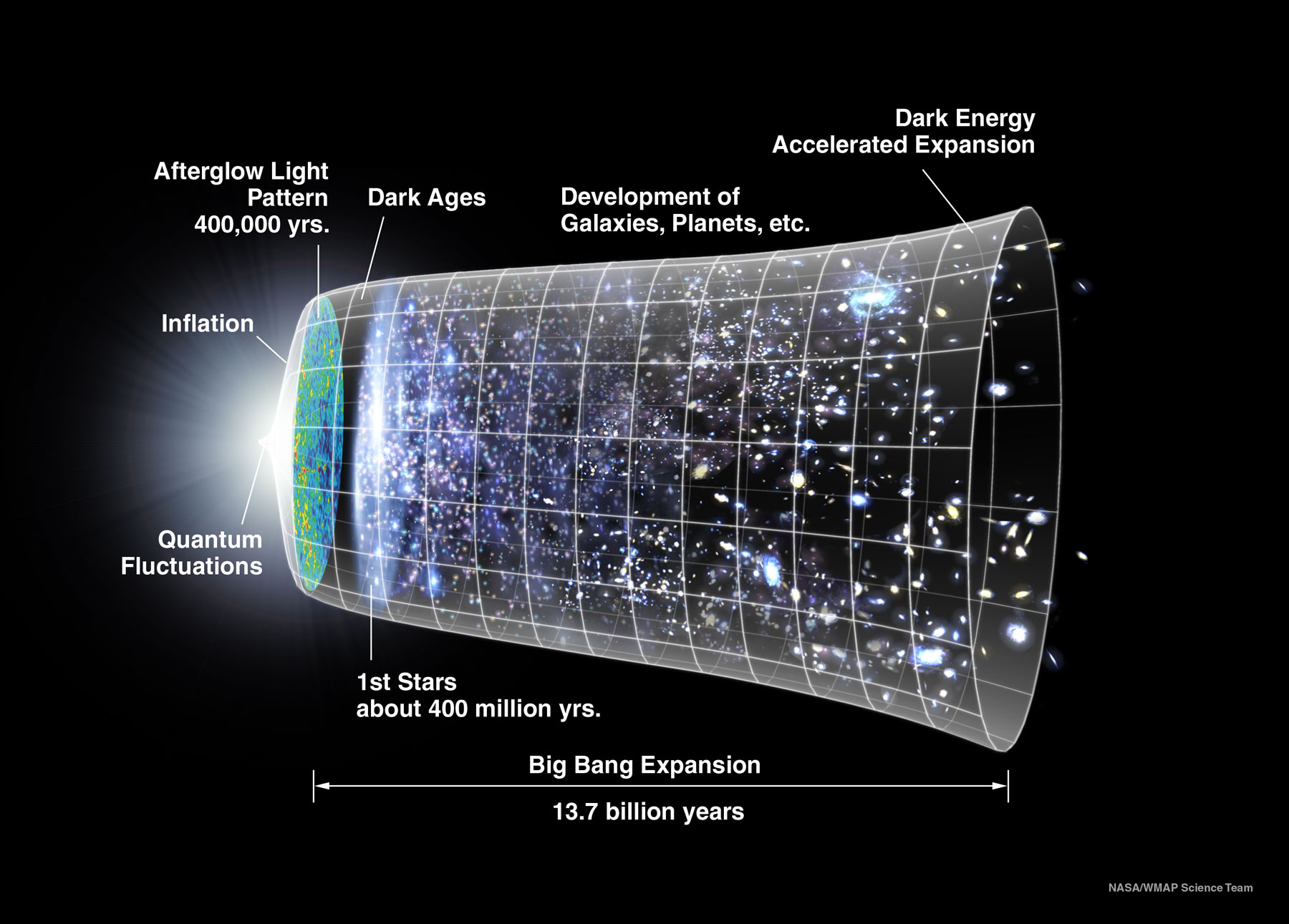
Right: Illustration of the timeline of the cosmos spanning the Big Bang Expansion (13.7 billion years). From left to right: quantum fluctuations, inflation, afterglow light pattern (400,000 years), dark ages, first stars (about 400 million years), development of galaxies, planets, etc., and dark energy accelerated expansion. https://www.darkenergysurvey.org/wp-content/uploads/2016/01/timeline.jpg
Science details:
DEcam is able to scan an area of the sky quickly and with a wide field of view, making it ideal to look for electromagnetic counterparts to gravitational waves. LIGO is not able to pinpoint the exact location of gravitational wave sources, which makes DEcam especially useful. The original goal of DES was to search for supernovae, so Soares-Santos had to adapt DEcam to also search for gravitational wave EM counterparts. She and her collaborators were successful in detecting these EM counterparts to the gravitational wave event GW170817 (due to two neutron stars colliding over 100 million years ago) in 2017, along with 6 other teams from different observatories.
This detection will help astronomers better understand the dynamics of neutron stars, as well as how heavy elements (such as gold and silver) were created - which requires an understanding of the high-energy astrophysical events that produce them. In the long term, these observations will contribute to furthering the understanding of the Universe’s accelerating expansion and uncovering the properties of dark energy.
Citations and resources:
https://www.brandeis.edu/now/2017/october/gravitational-SoaresSantos-waves.html
https://astrobites.org/2021/01/09/meet-the-aas-keynote-speakers-dr-marcelle-soares-santos/
Figures:
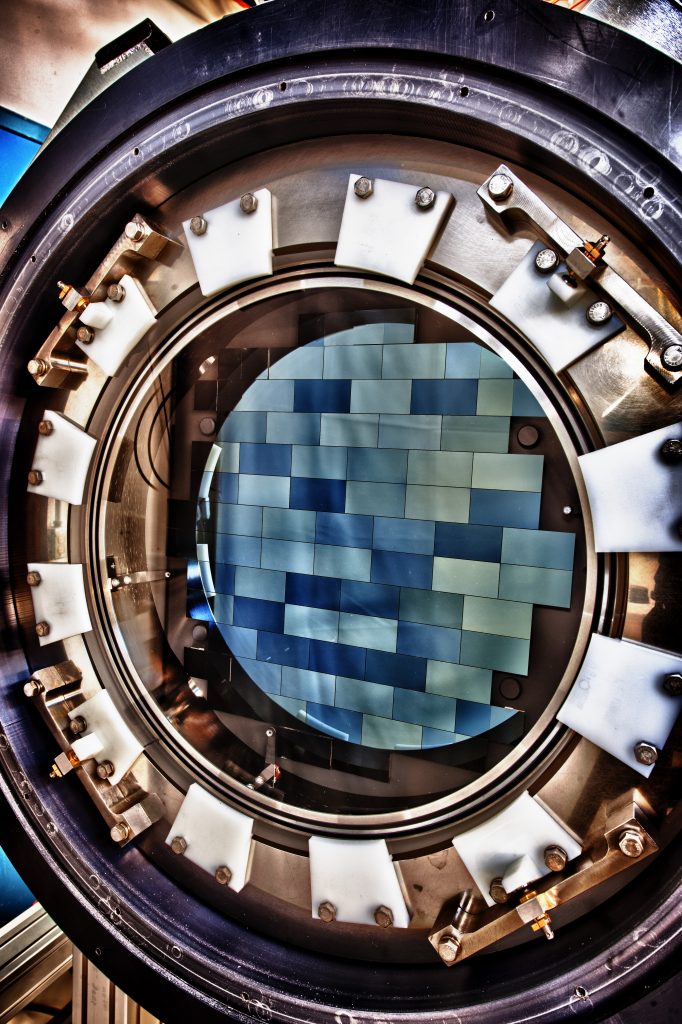
Left: DEcam imager with CCDs (blue) in place. The CCDs make up the main component of the imager and are arranged in a hexagonal pattern on the focal plane of DEcam. https://www.darkenergysurvey.org/wp-content/uploads/2015/04/11-0222-13D_hr2-682x1024.jpg
Right: Two optical images from the DEcam of GW170817 showing a transient source in the galaxy NGC 4993, its location is marked by the reticle. Its first detection occurred 0.5-1.5 days post merger (left) and is shown to have faded >14 days post merger (right). https://news.umich.edu/ligo-virgo-make-first-detection-of-gravitational-waves-produced-by-colliding-neutron-stars/
Slides by: Katherine Savard